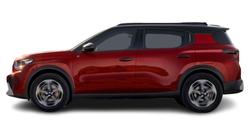
Could this second generation Citroen C3 Aircross be a small family's ideal second car? Jonathan Crouch drives it.
Ten Second Review
On paper, Citroen's revitalised C3 Aircross ticks almost every box for families looking for a small, versatile and stylish B-segment SUV. There's trendy looks, versatile cabin space (potentially for up to seven) and the choice of conventional, Hybrid or full-electric drivetrains. It's a car that'll really put its brand on the map in this sector.
Background
What if you could have the style and adventurous feel of a small SUV. Combined with the interior space and flexibility of a small MPV People Carrier? It's a combination of virtues that many brands have promised. But which possibly this car actually delivers - the Citroën C3 Aircross, in this second generation form completely redesigned around the latest Stellantis Group 'Smart Car' platform.
That chassis is this European conglomerate's base for the compact models it hopes will be able to compete in value terms with cars produced in lands with cheaper labour. We've already seen it introduced in a Citroen that shares much with this SUV, the fourth generation C3 supermini.
This is a very different kind of C3 Aircross to the car that back in 2017 launched Citroen's presence in the crossover segment for supermini SUVs and was substantially refreshed in 2021. Primarily, it's bigger, which means you can now have the seven-seat option that's unusual in this class. And there's also now a full-electric version - plus a full-Hybrid to compensate for the deletion of diesel. For a family in search perhaps of a second car, this is a very complete-looking contender.
Driving Experience
As expected, this C3 Aircross SUV fronts up with the usual portfolio of Stellantis Group powertrains for a car in this class - and of course they're all basically the same as those used by this model's C3 supermini sibling. If affordability is everything, you'll stick with the conventional option, 1.2-litre turbocharged three cylinder Turbo 100 petrol engine with 100hp, mated to that fast-disappearing kind of transmission, a manual gearbox (this one with 6 speeds).
For this second generation C3 Aircross, there's no diesel alternative. Instead, Citroen wants you to consider its 48V Hybrid powerplant, which is offered in 136hp form. Here, much the same 1.2-litre petrol engine is based around a unique 6-speed e-DSC6 auto transmission with an electric motor built into it, powered by a tiny battery. This motor can take over driving duties for up to 50% of the time in urban traffic.
If that's still not quite enough electrification for you, then you'll be directed to the all-electric e-C3 Aircross. This car was launched with the option of an entry-level 44kWh 'Standard range' battery but for our market, Citroen is focusing primarily on the larger 'Extended Range' 54kWh battery pack, which is capable of up to 249 miles between charges. It's paired to the 113hp front axle-mounted motor that usually features on small Stellantis EVs, propelling the car to 62mph in 13s en route to just 89mph flat out.
Whatever kind of powertrain you choose in your Aircross, you'll find that ride comfort is prioritised, a traditional Citroen attribute, thanks to the fact that the Advanced Comfort shock absorber hydraulic bump stops from larger models have been carried over to this one. Is it 'magic carpet-like', as Citroen suggests? No, not really; but it's certainly better than the class norm (and noticeably better than the equivalent - and otherwise identically-engineered - Vauxhall Frontera).
Design and Build
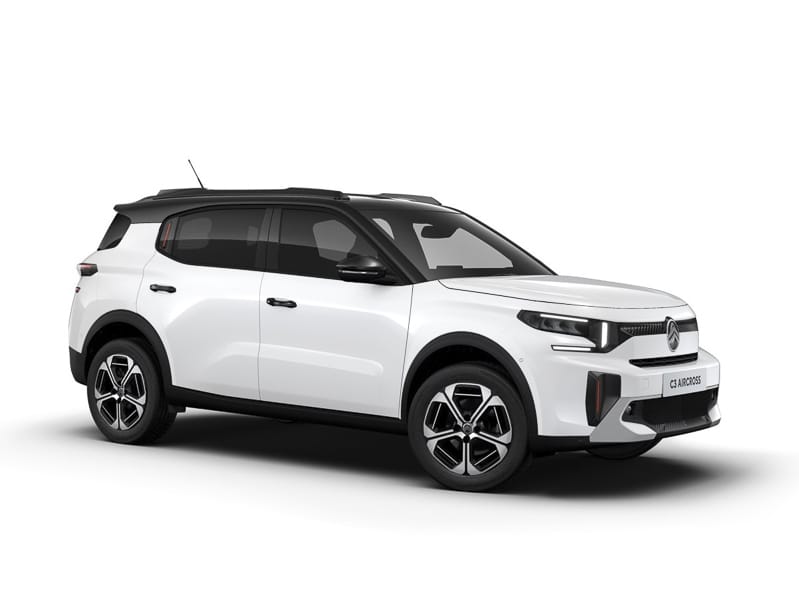
Predictably, the blocky, squarical styling that Citroen's decided will characterise its future models (derived from the company's Oli concept car of 2022) suits this C3 Aircross better than it does the fourth generation C3 supermini. Like the other Stellantis Group design in this segment that shares that conglomerate's 'Smart Car' platform, the Vauxhall Frontera, it's much bigger than the car it replaces, 200mm longer than the old C3 Aircross, with a much more overtly SUV vibe.
Larger wheels in arches with chunky cladding, extra ground clearance and roof rails all feature and the wings and wheel tracks are wider than the C3 donor model. The bluff front end sees the brand's new badge sitting prominently on the chevron-patterned grille. Personalisation was a draw for this car's predecessor and here again, the contrasting paint on the lower quarter panel and front bumper is customisable.
Inside, it's all very different from the previous model. As with the C3 supermini, this C3 Aircross features what Citroen calls a 'head-up display', which actually isn't that at all; instead, it's a narrow letterbox-like strip which houses a small selection of digital instruments, primarily speed and range. This works with the almost equally unusual oblong-shaped over-buttoned steering wheel. Avoid base trim and you get a central infotainment screen, a 10.25-inch monitor that at last Citroen has learned not to over-burden with climate controls, which are separated out lower down. Fabric inserts and novel detailing supply the required Gallic vibe, as do the squashy Advanced Comfort seats.
In the second row, there's comfortable room for a couple of adults (helped by a 2.67-metre wheelbase length that's the longest in the category). Unfortunately, unlike with the old model, there no sliding rear bench. Which this new-era C3 Aircross needs because (unusually for a B-segment SUV), it offers the option of a third seating row (though only on the combustion versions). As you can imagine though, that'll be pretty cramped and is intended for small children only.
Out back, five-seat versions get a decently-sized 460-litre boot (it's only 300-litres in a 7-seat model with the third row folded). In the five-seater, with the second row folded, there's up to 1,600-litres of space available.
Market and Model
At the time of our test in early 2026, prices for this second generation C3 Aircross were starting at around £21,500 for the conventional Turbo petrol version and from around £25,000 for the Hybrid - about the same as you'll pay for the equivalent version of the mechanically-identical Vauxhall Frontera.
Like its Frontera Electric Stellantis stablemate, this car was launched with an entry-level 44kWh 'Standard Range' battery but for the UK, Citroen primarily concentrates sales on the slightly larger 54kWh 'Extended Range' battery we tried. In this form, the e-C3 Aircross is a touch cheaper than the equivalent Frontera, listing at around £25,000 as we filmed, with an available £1,500 government grant to bring the price down to around £23,500.
Let's give you some more detail on the C3 Aircross line-up. All three of the powertrains available with this car can be had with base 'Plus' trim; with the Hybrid and the e-C3, there's the further option of finding another £2,000 for the better-specified 'Max' spec level we tried. The conventional Turbo petrol version comes only with manual transmission; as you might expect, the Hybrid and the e-C3 come only as an auto. Stick with a combustion engine in your C3 Aircross and you'll have the option of finding £765 more for a third seating row. Which if specified would create one of the cheapest seven-seaters on sale in the UK.
Base 'Plus' trim comes as standard with Citroen Advanced Comfort suspension, LED headlights and daytime running lights, rear parking sensors, a rear parking camera, cruise control with speed limiter and 17-inch alloy wheels. Inside, there's Advanced Comfort Seats and automatic air conditioning. Media stuff's taken care of by a 10.25-inch touchscreen with 'Apple CarPlay'/'Android Auto' wireless smartphone mirroring
If you can stretch to the second trim level, 'Max', then you'll also get 3D LED rear lights, a white or black bi-tone roof (depending on the body colour) and front parking sensors. Along with 3D navigation, wireless smartphone charging, an electrochrome interior mirror and a winter pack comprising of heated seats, a heated steering wheel and a heated windscreen.
As for safety spec, well all C3 Aircross models come with active safety braking, an active lane departure warning system, driver attention alert and traffic sign recognition. Plus six airbags linked of course to an eCall system. With 'Max' trim, there's standard blind-spot detection too.
Cost of Ownership
Small SUVs can't be as efficient as the superminis they're based upon: extra weight and bluffer aerodynamics put paid to that. This C3 Aircross is no exception to that rule, in terms of weight tipping the scales at about 100 kilograms more than an ordinary C3. That exacts a penalty of about 10% on the fuel and CO2 emissions figures you can expect - which is a premium that we expect most potential owners will be quite happy to pay in return for the extra fashionability of running a car of this kind. It's worth pointing out though, that the inherent lightness of that standard C3 means that this SUV version's extra weight doesn't leave it as being a particularly heavy car. It doesn't actually weigh very much more than something like, say, an ordinary Vauxhall Corsa supermini. And the result should be a very efficient set of running costs. You can expect 50.2mpg on the combined cycle and 135g/km of CO2 from the conventional 1.2-litre Turbo 100 variant. With the 48V Hybrid model, you could improve that to 57.4mpg and 120g/km.
Citroen claims that the E-C3 Aircross is capable of up to 188 miles of range and rapid charging at rates of up to 100kW, which allows for a 20-80% charge in 26 minutes. At home, you'll be able to AC charge from 20-80% from 7.4kW garage wall box in just over 4 hours. If your property has a three-phase supply, you'll also be able to charge at 11kW, in which case the 20-80% charging time will fall to just under 3 hours. All versions of this model will be covered by the brand's usual unremarkable three year/60,000 mile warranty, plus the battery will have its own eight year cover package.
Summary
If the automotive market was sensible and rational, this would be a small MPV - like the old C3 Picasso. And in many ways it is: just one with an SUV mindset. We like that combination and there's no reason why potential buyers shouldn't too. This rejuvenated second generation C3 Aircross isn't especially fun to drive, but few B-segment SUVs are. What actually matters is that it's fun to look at and nice to sit in, which ought to also make it good to own. Yet at the same time, this model's pretty much as practical as the MPV it probably would have been a few years ago.
Its other main attributes are distinctly Citroën ones. The cossetting 'Advanced Comfort' seats and shock absorber hydraulic bump stops. The colour-co-ordinated look. Light kerb weight and efficient engines, which together mean very competitive running costs. And up-front affordability which could easily see you in a C3 Aircross at a substantial saving over comparable versions of key class rivals.
And in summary? Well this is Citroën's idea of what a small SUV of this kind should be - and that makes it a little different from your other choices in this class. Which might mean you'll end up liking this car a lot more than you thought you were going to.

.jpg)
.jpg)