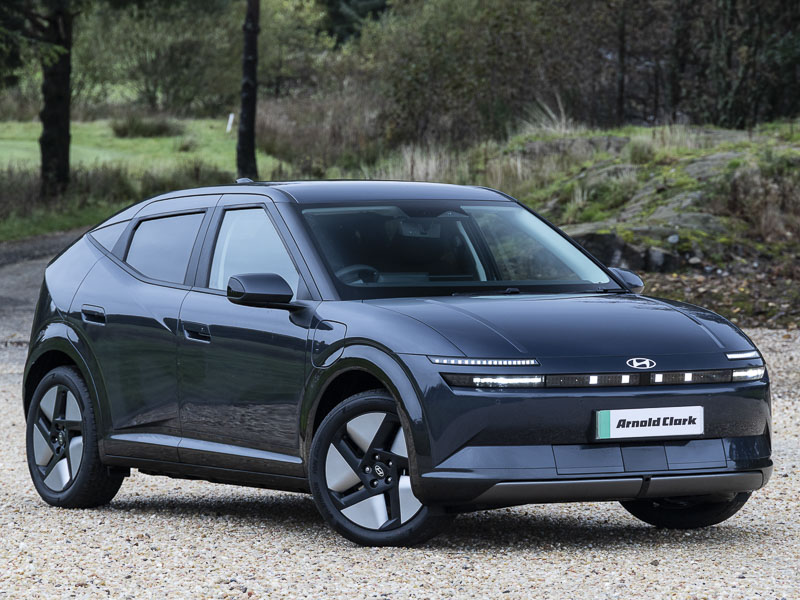
Hyundai's smallest IONIQ model might also be its best. Jonathan Crouch takes a look at the IONIQ 3.
Ten Second Review
Hyundai muscles into the sector for compact EV hatches with this car, the IONIQ 3. It's aggressively styled and ambitiously designed. And it might just be the more interesting segment contender this class has been waiting for.
Background
The IONIQ 3 could hardly be more important for Hyundai. This compact EV is the smallest car yet in its IONIQ electric model line and the first full-battery model the Korean maker has built in Europe and designed specifically for our continent.
Given that all of this makes the IONIQ 3 the most important electric Hyundai sold here to date, you might expect the company to play it somewhat safe with the design. But the Hyundai Motor Group conglomerate already has the almost identically-engineered Kia EV2 doing that in this segment. So the IONIQ 3 must stand out - and does. With aero styling, a novel dash design and sizing that blurs class boundaries. Let's take a closer look.
Engines and Tech Spec
As the IONIQ 5N and 6N models have shown, Hyundai knows how to make fast, dynamically rewarding electric cars. Perhaps in future, a hot N version of this IONIQ 3 will be one of them but for the time being, the sporting looks of this compact EV hatch are the most sporty thing about it.
As we've said elsewhere in this review, all the engineering is shared with the sensibly-orientated Kia EV2, which means The drivetrain bolted to the E-GMP platform offers a choice of two batteries. Of minority interest is the standard range 42.2kWh pack, paired with a 147PS front motor. Almost all IONIQ 3 customers will instead choose the larger long range 61kWh unit which, despite the extra bulk it lends to the kerb weight, must make do with a feebler 135PS motor, hence a 9.5s 0-62mph time that's 0.7s lower than the cheaper variant. Either way though, there's 250Nm of pulling power and top speed is 105mph for the 42.2kWh model, or 102mph for the 61kWh variant. More importantly, driving range is up to 213 miles for the standard range 42.2kWh version; and up to 308 miles for the 61kWh long range variant.
The small wrist flick-sized steering wheel will make the car feel a little more agile than it actually is. You can expect refinement to be excellent thanks to the slippery shape. On the highway, you'll certainly appreciate the trouble the brand has gone to in order to limit road, tyre and suspension noise. There's a brake regen system of course - controlled by paddles behind the steering wheel, with modes including a full-on 'i-Pedal' setting which will bring the car virtually to a stop when you come off the throttle.
Design and Build
Several things are interesting here. First that this is a car designed entirely around its 'aero hatch' shape. As we'll see, cabin functionality has had to conform in pursuit of the IONIQ 3's range extendingly-slippery 0.26Cd drag factor figure. To give you some perspective, its almost identically-engineered but more conventional Kia EV2 segment cousin manages 0.29Cd.
Where that EV2 sticks to conventional supermini sector sizing, this Hyundai's 4,155mm length (95mm longer) leaves it halfway towards something slightly larger - say a Volkswagen ID.3 Neo or a Renault Megane. That swept-back shape (based on the Korean maker's 'Concept Three' Munich Motor Show concept car) disguises a lot of that extra bulk, further aided by a new 'Art of Steel' design philosophy that's most evident in the sharp creases that point up towards the coupe-like rear end with its prominent spoiler. The idea is to make it look as if steel has been draped over the body.
Hyundai set out to make the styling 'polarising', with a low front end, a raked-back windscreen and colour-contrasting wheel arches that give a squat stance. There's the brand's trademark pixel lighting and, rather curiously, four dots at the front and rear of the car, said to represent 'H' in Morse code.
It's also interesting inside, the first thing you'll notice behind the wheel being the dash top instrument panel you view over the top of the wheel rim, rather than conventionally through its spokes. Given that this is all about keeping the driver's eyes on the road, a Chinese-style button-less cabin would have been inappropriate and, sure enough, plenty of conventional switchgear has been retained, with some of the buttons designed around the imprint of a finger.
The centre screen looks simply enormous alongside that letterbox-shaped instrument display - or at least it does in its largest 14.6-inch form (a smaller 12.9 -inch screen features with cheaper trims). Both use the brand's latest Android Automotive Pleos Connect infotainment system. There's also a big space beneath the centre console which you can extend into a storage area for large flasks by taking out one of the cup holders.
You might expect that tapering rear roof line to eat into back seat head space but Hyundai has carved into the car's headlining to free up some extra cabin height and the rear seats are slightly sunken, with a completely flat floor ahead. So a couple of adults will fit OK, though they won't be as comfortable as they might be in an EV2 or an ID.3.
The other area where Hyundai has pulled a rabbit out of the hat is in boot space, which you'd think the swept-back silhouette would make minimal. Not so. The 322-litre boot capacity is actually OK and, as with a rival Ford Puma GEN-E, you can hugely extend it (in this case by up to 441-litres) by making use of a simply enormous space beneath the boot floor. Which is some compensation for the lack of the kind of under-bonnet 'frunk' you'd get in an EV2 and in some other class rivals. There's 1,213-litres of space with the rear seat folded.
Market and Model
There are four trim levels - 'Advance', 'Premium', 'Ultimate' and 'N Line Evo'. As with this model's almost identically-engineered close Hyundai Motor Group cousin, the Kia EV2, all versions of the IONIQ 3 qualifiy for a government Electric Car Grant - at the top £3,750 level. After grant deduction, the entry-level 42kWh 'Advance' version costs from just under £18,500. The 'Advance' version of the 61kWh model is priced from around £22,000, once you've deducted the Grant. Grant-deducted prices range up to around £28,000.
Base 'Advance' spec includes 16-inch alloy wheels, LED front headlamps and rear lamps, front and rear parking sensors, a 12.9-inch infotainment screen with wireless Android Auto and Apple CarPlay, dual-zone automatic climate control, rear view monitor, smart key with push-button start, smart cruise control with stop-and-go and an electronic parking brake.
The IONIQ 3 'Premium' adds 17-inch alloy wheels, privacy glass, battery heating and pre-conditioning, a 9.9-inch digital information cluster, rain-sensing windscreen wipers, electrically folding door mirrors, a wireless smartphone charger, seat back pockets, a solar windscreen and passenger seat height adjustment.
Plusher still is 'Ultimate' trim, which adds 18-inch alloy wheels, navigation for the 12.9-inch infotainment system, matrix LED headlamps with dynamic welcome function, heated front seats, a heated steering wheel, a rear seat armrest, front seat lumbar support, rear air vents, reclining rear seats, cabin ambient lighting and Highway Drive Assist with hands-on detection and navigation-based smart cruise control. Finally, the top 'N Line Evo' variant has an N Line exterior design package, 19-inch N Line alloy wheels, a 14.6-inch infotainment display with navigation and wireless Android Auto and Apple CarPlay, suede and cloth N Line seats, N Line interior design with red accents, a surround view monitor, a blind spot view monitor, parking collision avoidance assist, 360-degree parking sensors, remote smart parking assist and Memory Reverse Assist.
All IONIQ3s get plenty of safety and drive assist kit, but you might object to all the binging and bonging from it, so try before you buy. The portfolio includes High Beam Assist, Forward Collision-Avoidance Assist, Lane Keep Assist with Lane Follow Assist, Rear Cross-Traffic Collision-Avoidance Assist and Blind-Spot Collision-Avoidance Assist.
Cost of Ownership
DC charging speed isn't anything to write home about, rated at 119kW for the 42.2kWh version and just 110kW for the volume 61kWh version. Unlike the larger 800V IONIQ 5, the IONIQ 3 can only offer 400V charging technology, so has no ultra-rapid DC charging capability - though that's still the norm in this segment. The 61kWh long-range variant most will choose can charge from 10-to-80% in 30 minutes when plugged into a 150kW DC fast charger (it's 29 minutes for the 42.2kWh standard-range version).
What about charging at home? Well the long-range version requires 8 hours 35 minutes for a full charge when plugged into a single-phase 7.4kW wallbox; it'd be 6 hours 20 minutes for the standard-range version. Obviously, if you've a three-phase 11kW wallbox, the times are much quicker. When plugged into an 11kW AC charger, the IONIQ 3 long-range can charge from 10-to-100% in 5 hours and 35 minutes (it's 4 hours and 5 minutes for the standard-range version).
Both available batteries are warmed by a clever thermally-efficient sheath heater with multiple maps for low and high temperature charges. Kia says that because this enables the battery to self-heat at temperatures down to minus-35-degrees C, charge times are significantly lowered and efficiency-killing precipitation of the battery's lithium-ion cathodes is avoided. There's also a Battery Conditioning Mode that can optimise battery temperature when heading to a fast-charging station. This can be manually activated or can work automatically linked to GPS data.
Summary
We can see the potential for strong sales here. There must be plenty of EV customers who can't decide between a compact supermini-sized small hatch (like, say, a Vauxhall Corsa Electric or a Volkswagen ID.Polo); or a slightly bigger near-family hatchback-sized one (like, say, Volkswagen ID.3 Neo or a Renault Megane). And find themselves a bit bored by the options on offer. Size-wise, the IONIQ 3 gives you a bit of both - and does so with an interesting aero swagger.
It joins the Kona Electric in filling the previously rather large gap in the Korean maker's EV line-up between the dinky Inster and the family-sized IONIQ 5 - though sadly doesn't get the latter model's more advanced 800V electrical architecture. But you'll feel at the cutting edge of EV design if you choose an IONIQ 3. And for quite a few likely customers, that'll be what really matters.