Hyundai's fourth generation Tucson mid-sized SUV has a smarter look and feel - and a very clever Hybrid engine. Jonathan Crouch drives the improved version.
Ten Second Review
Hyundai has almost fully electrified the engine line-up used with its fourth generation Tucson mid-sized SUV, but you'll need a full-Hybrid powerplant of some kind to see a real efficiency benefit. Probably the one used in this front-driven Hybrid HEV variant. Here, we look at the revised model.
Background
For some time now, the established brands have been unable to ignore Hyundai - and they certainly won't be able to ignore the improved fourth generation version of its Tucson mid-sized SUV. The Tucson has yet to break into the top five sellers in its class, where cars like Nissan's Qashqai, Volkswagen Tiguan and Ford's Kuga tend to dominate, and it isn't going to unless it dresses itself in a form that's going to make people really sit up and take notice. Well the enhanced version of this 'NX4'-series MK4 model certainly does that.
This fourth generation model still offers a token conventionally powered unit at the foot of the range, but otherwise everything on offer is in some way electrified: mild hybrid, full hybrid, plug-in hybrid - take your pick. It's the full-Hybrid HEV version we try here.
Driving Experience
For electrified engine technology that'll really make a difference to your Tucson, you'll need some sort of full-Hybrid powertrain, your options for that beginning with the HEV Hybrid model we look at here, which has no engineering or handling changes in this lightly improved form - though can now be ordered with the option of 4WD. With all versions of this HEV variant, a 'Prius'-style self-charging petrol/electric engine working with a 6-speed auto gearbox is mated to a 60PS electric motor powered by a 1.49kWh battery, which provides sufficient extra urge to this powertrain's combined power output to 239PS. Enough to deliver a 62mph sprint stat of 8.2s and a top speed of 116mph. Braked towing weight is 1,510kg, 300kg more than the PHEV version.
Although the battery on offer in a Tucson HEV isn't very big, it's very good at constantly replenishing itself with regenerative energy, so that much of the time in town travel, you'll be able to cruise through the urban sprawl in a dignified silence. You can leave the powertrain to do its own thing, or use the centre console HEV/EV button to make your own choice between full-Hybrid or full-Electric motion - though the latter won't last for very long.
You might not be quite so impressed out of town. The self-charging full-Hybrid system adds 73kgs of weight, enough to see a well equipped Tucson HEV model tipping the scales at nearly 1.7-tonnes. Combining that with the electric motor's relatively feeble output can only have only one result: a frequent propensity for the 1.6 T-GDi petrol unit to kick in (sometimes quite vocally) virtually all the time in usual driving. Once it has, should there be a need for more urgent forward thrust, then a prod of the throttle is accompanied by a pleasing initial stab of electrified torque, but this doesn't last for long because torque is more restricted than it would be with a comparably-powerful diesel-engined rival.
Design and Build
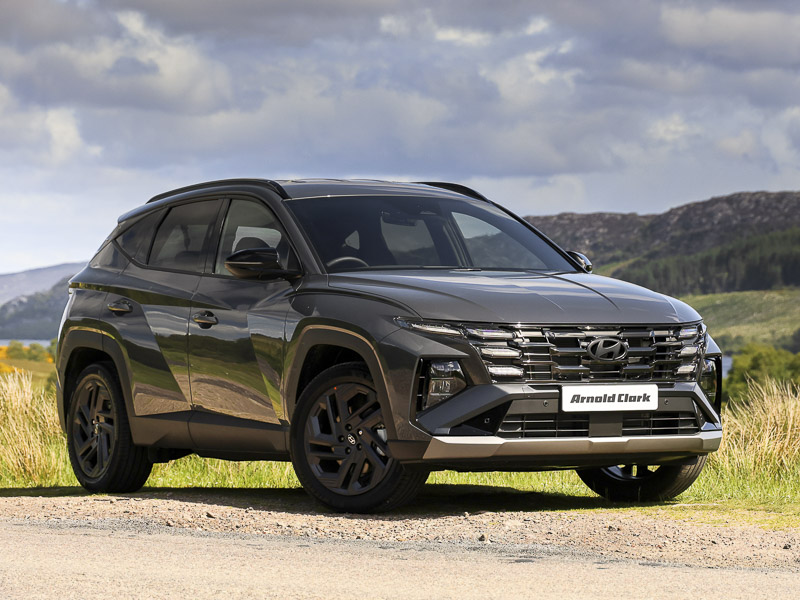
There's little to differentiate this HEV Hybrid Tucson variant from other derivatives in the range and the updates to this fourth generation 'NX4'-series Tucson model are uber-subtle. Look closely and you might notice the thinner, more angluar lines of the radiator grille and the revised front bumper. As before, the front end styling is dominated by the brand's 'Parametric Jewel' daytime running lights borrowed from the company's previous Vision T concept, which represented what Hyundai has called 'a design revolution'. The 'jewel-like' running lights are integrated into the sides of the 3D grille and can't be distinguished from it when switched off. As before, this MK4 model is oner of the larger mid-sized SUV segment models, at 4.5-metres long. And sits on big wheels of between 17 to 19-inches in size.
Inside up-front, the changes to this facelifted model are much more noticeable. Borrowing from the cabin design theme seen in the company's latest EVs, the twin screens are now 12.3-inches in size (up from 10.25-inches before). One is for the instrument cluster; the other is for the centre stack and incorporates Hyundai's latest Bluelink telematics. The redesigned dashboard has a new horizontal crash pad design supposed to create a sense of openness. Physical heating and ventilation controls and a redesigned centre console with buttons for regularly used functions feature on the new centre console, whilst the automatic and hybrid powertrains feature a wireless charging pad housed in the centre armrest.
As before, there's quite a spacious back seat - a 10mm longer wheelbase increase for the original version of this MK4 model improved that and added 26mm more legroom. The boot is hardly compromised at all in this HEV form, with a 616-litre capacity that's just 4-litres less than the base un-electrified 1.6 T-GDi model. Fold the back seat and you'll have up to 1,795-litres. The Plug-in version can only manage 556 and 1,721-litress. The MHEV Mild Hybrid variant, in contrast, offers 620 and 1,799-litres.
Market and Model
There are five trim levels - 'Element', 'Black Line', N Line Edition', 'N Line S' and 'Ultimate' - and Tucson HEV prices start at around £35,000, just over £2,000 more than the automatic version of the mild hybrid model.
All variants are well equipped. Base 'Element' trim includes black roof rails, dual-zone climate control, cloth interior upholstery, 40:20:40 split-folding rear seats, wireless phone charging, Apple CarPlay & Android Auto, a Smart Key FOB with engine start button, 17-inch alloy wheels, E-Call, front and rear parking sensors and a rear-view camera.
Mid-level 'Black Line' spec adds 19-inch alloy wheels with satin grey detailing, a satin grey Hyundai logo in the front grille, black door mirrors, black window surrounds, rear privacy glass, LED rear combination lamps, a 12.3-inch TFT digital driver display, metal door tread plates, cloth and leather upholstery, heated front seats and a heated steering wheel.
In addition to the features listed above, the plusher 'N-Line Edition' includes N-Line styling, body-coloured wheel arches, a Krell Premium audio system, 3-zone climate control, heated rear seats, a smart power tailgate, head-up display, Matrix LED headlamps, remote folding rear seats and Highway Drive Assist.
Cost of Ownership
The efficiency figures reveal that Hyundai's MHEV mild hybrid tech gives you hardly any benefit over the standard version of the brand's 1.6 TGDi petrol engine. It all merely illustrates what we've been saying for some time, which is that mild hybrid tech doesn't really have much to offer the modern motorist. To start seeing more of an efficiency benefit, you'll need a full-Hybrid engine - one that is able to run independently on battery power. The HEV self-charging unit fitted to the Hybrid petrol model can certainly do that. Though not for very long, thanks to the combination of a near-1.7-tonne kerb weight, a relatively feeble 60PS electric motor and the small size of the 1.49kWh lithium-ion polymer battery pack that powers it.
Still, this front-driven HEV model's emissions efficiency showing - 126g/km of CO2 - is much better than you'd get from a diesel rival, even a more feebly-powered one. A Volkswagen Tiguan 2.0 TDI diesel returns 135g/km. This Tucson HEV's 50.4mpg combined fuel return is close to that recorded by that Tiguan too. These days, unless you're planning to tow with your mid-sized SUV, it's really hard to make a case for choosing a diesel with it - and those figures clearly illustrate just why. With a full-Hybrid engine, it's all good.
Summary
If you're looking for efficiency, then this HEV Hybrid Tucson model has far more to offer than its MHEV Mild Hybrid range stablemate. But Hyundai still has to work out a way to make all Tucson variants - including this one - ride and handle with the polish common to the best of this car's mid-sized SUV rivals. The marque also needs more of a brand identity, though with future models all now slated, like this one, to carry a more distinct and individual personality, it seems likely that the days when people primarily chose a Hyundai merely on the basis of price and value will soon be behind us.
Overall, there's no doubt that with this NX4-generation design, this Korean maker really turned quite a corner - a switch from delivering the kind of mid-sized SUV you might need to providing one you might genuinely really want. Which of course, as every modern brand knows, makes all the difference in the world in such an over-crowded segment. Historically, the Tucson model line has needed a bit of a spark to really ignite its appeal. Well that's been delivered here - in every sense.



.jpg)
.jpg)
.jpg)
.jpg)
.jpg)
.jpg)