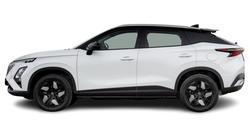
Chinese brand Omoda tries Hybrid power in the compact crossover segment with this car, the Omoda 5 SHS-H. Jonathan Crouch takes a look.
Ten Second Review
Omoda brings us its first ever full-Hybrid in the form of this car, the Omoda 5 SHS-H. At a stroke, it brings this distinctively styled Chinese compact crossover contender into the orbit of combustion customers who wouldn't previously have considered it.
Background
Omoda's very first UK model, the Omoda 5, has sold remarkably well given its original powertrain line-up. This offered a choice between a full-EV, the E5, which was OK but sold in a hesitating market. And a petrol Omoda 5 that performed eagerly but was woefully inefficient. Now though, this growing Chinese brand has bought UK customers the kind of a Omoda 5 they might want in larger numbers - this SHS-H Hybrid version.
It's a Omoda's first-ever full-Hybrid and the arrival of this variant has been described as 'a milestone moment' for the brand. But just how good is this car? Let's take a closer look.
Engines and Tech Spec
The SHS-H 'Super Hybrid System - Hybrid') set-up in use here comes from parent group Chery's parts shelf and pairs a turbocharged 1.5-litre four cylinder petrol engine with a compact electric motor energised by tiny 1.83kWh battery pack.
Some rivals in the segment (the Nissan Qashqai e-Power for instance) work as 'series Hybrids', with drive offered only by an electric motor, the engine provided solely to generate energy for the battery. This Omoda 5 uses a more conventional Toyota-style full-Hybrid system with the engine and motor working in tandem to power the front wheels. That power works through the Cherry Group's own three-speed 'DHT' auto gearbox ('Dedicated Hybrid Transmission') optimised to work with petrol/electric powertrains. Combined power output is rated at 204bhp, with 0-62mph requiring 7.9s en route to 108mph.
Handling was developed in Europe and benchmarked against what the brand sees as this car's closest rival the Hyundai Kona. The suspension, steering and anti-roll bars have all been re-tuned over the Chinese market model to cater for differing European tastes. Don't expect cutting-edge handling or particularly feelsome steering but the drive dynamics are reasonably class competitive.
Design and Build
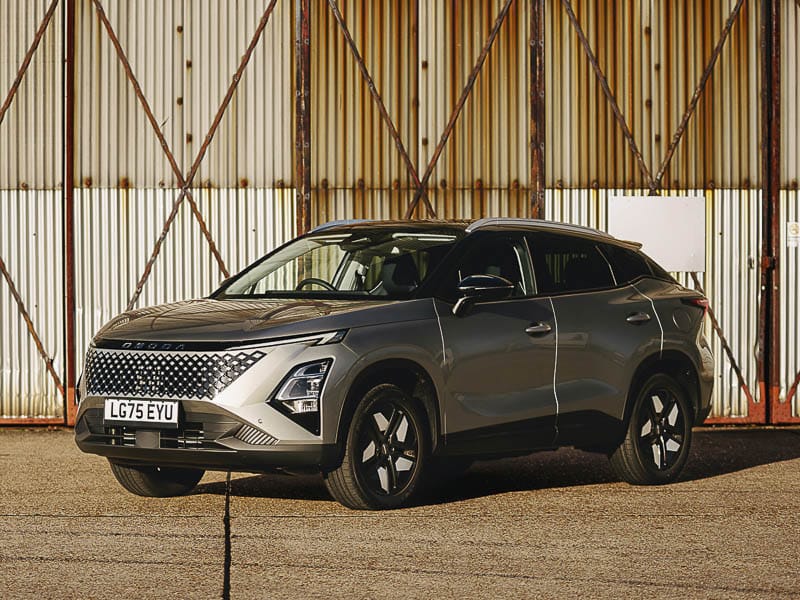
In its original form, to get the Omoda 5 with really appealing looks, you had to get the petrol version, the E5 EV variant having been beaten with the ugly stick. Now though, in the form of this SHS-H model, you can get a combustion version that actually has the great looks but is affordable to run. Actually, this Hybrid derivative has a slightly different front grille to the ordinary petrol version - and a different 18-inch wheel design.
Omoda is determined that fashionable design should be a major selling point of this model, which is why you'd be unlikely to mistake the Omoda 5 for anything else. Certainly not the two cars this 4-metre-long compact family crossover is primarily pitched against, the Nissan Qashqai (which is slightly longer) and the Hyundai Kona (which is a little shorter). The main visual talking point is a huge grille which is almost completely flush with the front bumper. The rear gets a full-width light bar. There's a rakish profile with blanked-out C-pillar.
Inside, where everything is of surprisingly high quality for a mainstream brand, there's a high-mounted 10.25-inch infotainment screen. And a digital instrument cluster of the same size built into a single wide panel mounted on top of the dashboard. You're going to need to like smudge-worthy gloss black-trimmed panelling, but everything is decently screwed together and the things you interact with regularly are soft to the touch. Plus there's adjustable ambient lighting that varies itself with the selected drive mode.
Despite the gently sloping rear roofline, there's plenty of headroom in the back, even with a sunroof fitted. And decent leg room for six-footers too. Out back, there's a 380-litre boot (the same as a Golf). The trunk area lacks bag hooks but gets a low loading lip, so it's easier to slide heavy items in.
Market and Model
Unlike its Chinese counterpart BYD, Omoda isn't immediately trying to match prices against the established players in this segment. At its launch, the Omoda 5 SHS-H in base 'Knight' form cost from just under £26,000, around £1,750 more than the conventional petrol version. With just over £29,000 required for the plusher 'Noble' version. For reference, the all-electric EV variant starts at around £33,000.
You might expect a new aspirational electrified brand to be selling online, with agency models and subscription services. But no: Omoda sells its cars here via traditional dealerships, which cover most major UK centres and you can find your nearest one by going to omodauk.com. The brand has lent heavily on advice from its partner Jaguar Land Rover for its establishment in the UK; Omoda parent company Chery handles local Chinese production of various JLR models for that Far Eastern market.
As you'd hope, there's lots of equipment included as standard across two Omoda 5 SHS-H trim levels. Base 'Knight' spec includes 18-inch alloy wheels, full LED lighting, dual 12.3-inch digital displays, wireless 'Apple CarPlay' and 'Android Auto', intelligent voice control and plenty of driver assistance and safety systems. Top 'Noble' spec builds on this with a 540-degree surround-view camera, an 8-speaker SONY audio system and ambient interior lighting, plus heated and ventilated front seats.
Cost of Ownership
You wouldn't expect more recent Chinese brand Hybrid technology to be quite as efficient as that of mainstream rivals who've been developing it for decades - and it isn't. But the differences aren't huge. The Omoda 5 SHS-H manages 53mpg on the combined cycle and 120g/km of CO2, a big step up from the 34mpg and 170g/km of the un-electrified petrol Omoda 5. But look at the class standard; a rival Toyota Yaris Cross Hybrid manages 62.7mpg and 109g/km.
So it's a little adrift, but Omoda still reckons the SHS-H will get 650 miles from a tank of fuel. Compare the 267 mile figure of a comparable full-electric Omoda E5 and it becomes obvious why customers are hesitating over the EV switch. And why the introduction of this Hybrid model was so crucial to Omoda.
Most new brands offer comprehensive warranties and this one is no different. Omoda includes a 7 year/100,000 mile warranty with all its cars. Servicing needs are quite frequent; garage visits are needed every year or 10,000 miles, whichever comes first. Affordable servicing plans are available though, at point of purchase and servicing turnround times will be aided by a UK parts warehouse established in cooperation with DHL. There's 24/7 RAC roadside assistance too, which renews with each service up to the end of the warranty.
Summary
The Omoda 5 SHS-H isn't the cheapest family Hybrid hatch you could choose, but it's the cheapest one that doesn't feel like you've scrimped and saved to get it.
The striking looks will stand out in the supermarket car park and don't smack of the kind of budget brand you might expect to have to settle for to get a full-Hybrid of this size at the £25,000 price point. True, more expensive rivals have more efficient Hybrid systems but if you don't want to have to find the premium they'll ask you to pay, then you might find quite a lot to like here.

.jpg)
.jpg)