Volvo's cool-vibed EX30 has taken its brand into a completely new, more affordable EV segment. Jonathan Crouch drives it.
Ten Second Review
The EX30 is a different kind of Volvo, a small posh EV for a new era and a model that is bringing enormous conquest sales for the brand. It's more affordable than you might be expecting and would perhaps make an ideal second car for upwardly mobile families embracing the electric revolution. It's been lightly updated to create the model we're going to look at here.
Background
Just about every mainstream car maker right at present seems to be trying to re-invent itself as an all-electric brand. In most cases, particularly with the premium makers, that seems to involve bringing us futuristic-looking EVs priced far out of the reach of most ordinary customers. Volvo wants to be different. And proof of that comes with this car, the EX30.
This Chinese-owned Swedish brand can only survive by attracting new breed of younger customers and the EX30 is its most important car yet in reaching them. The brand says this model's job is to 'bring premium full-electric mobility to a much broader audience' and three-quarters of the people who choose it will never have considered a Volvo before. It's pitched and priced well below the company's existing EX40 and EC40 Volvo electric models that compete with the base EVs from other premium brands like Audi, BMW and Mercedes. And sized interestingly, somewhere between an EV supermini and an EV family hatch. That means lower pricing than you might expect, which is crucial if Volvo is to get anywhere near its rather over-ambitious target of achieving 50% EV sales across its model mix by 2025. Sounds interesting. Let's take a closer look at this car, lightly updated for the 2026 Model Year.
Driving Experience
The main change made as part of the EX30's Model Year 2026 update was the introduction of a new entry-level single motor P3 powertrain that develops 150hp. This is available with the car's usual battery choice; either a 51kWh pack (offering up to 210 miles); or a larger 69kWh Long Range battery (offering up to 295 miles between charges).
This base unit was much-needed because prior to its introduction, the entry-level power point for EX30 ownership was with a 272hp single motor P5 powertrain a little too powerful for many customers' needs (it takes just 5.3s to dispatch the 0-62mph sprint). The range figures are very similar to those of the base variant - up to 209 miles for the 51kWh version or up to 300 miles for the 69kWh Long Range model.
From original launch, the fastest Twin Motor P8 AWD version of this EX30 was the quickest-accelerating Volvo ever built. This fastest model adds an extra motor on the front axle to create all-wheel drive and boost total output to a stonking 428hp; enough to storm a P8 EX30 to 62mph in just 3.6s. It only comes with the Long Range 69kWh battery and makes up to 280 miles between charges. Volvo also offers the EX30 in rugged-ised 'Cross Country' form, in which guise you can only have the larger 69kWh battery with either the 272hp or the 428hp drivetrains.
Whatever kind of EX30 you choose, under the skin lies the most compact version of the Geely Group's 'SEA' 'Scalable Experience Architecture' platform, engineered here to produce a well-judged standard of ride. Body roll's well resisted too, which might have made for an engaging confection were it not for the rather lifeless steering. There aren't any provided drive modes, nor are there the steering wheel paddleshifters to control brake regeneration that some other competitors offer. Just a 'One Pedal Drive' setting activated via the centre screen - and even that doesn't slow you particularly fiercely.
Design and Build
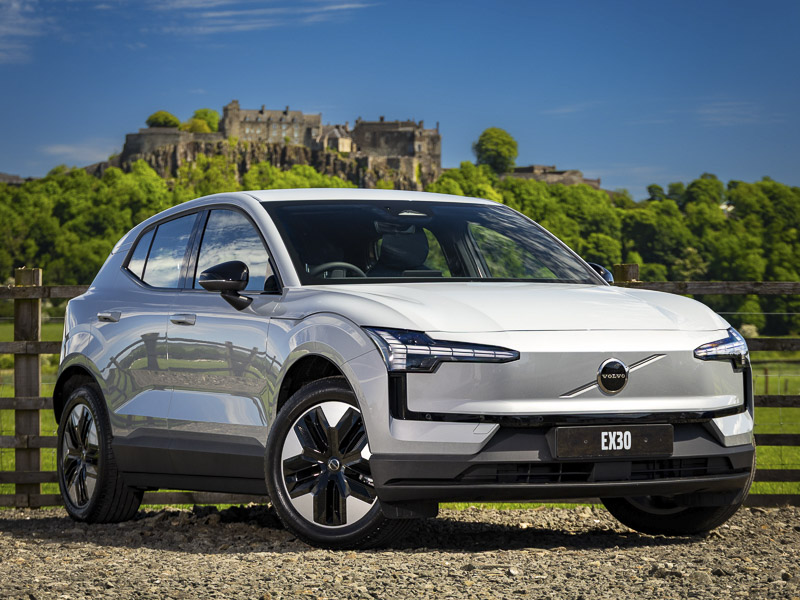
This is Volvo's smallest-ever EV - and perhaps also its most charismatic. Ex-Design chief T.Jon Mayer reckoned that the front end was inspired by Star Wars storm trooper sci-fi helmet design. There's certainly a family resemblance to the brand's larger EX90 SUV, with a closed-off grille and the marque's usual 'Thor's Hammer' headlights. Big wheel sizes vary between 18 and 20-inches. And there are some unusual available colours, including a 'Moss Yellow' apparently inspired by lichen that grows on rocks on the West coast of Sweden. The twin-level rear lamp clusters are interesting too. And short overhangs emphasise the compact 4,233mm length.
The interior really is a clean sheet design, like nothing we've ever previously seen from a Volvo. Though you may detect shades of Tesla in the absence of an instrument binnacle and the way that everything - including all the drive gauges - has been located on a centrally-positioned 12.3-inch vertically-mounted Google-based touchscreen, which for the 2026 model year got a UX package of updates to improve functionality. Unusual is the lack of door-mounted speakers - a sound bar runs across the full width of the dashboard instead. Cupholders slide out of a bulky-looking central armrest; the glovebox and the electric window switches are centrally placed; the central tunnel incorporates a removable storage box; and there's a tray accessible to rear seat passengers. There's only room for a couple of them, but the longer wheelbase made possible by the EV-specific SEA platform helps with leg room. The boot capacity is rated at 318-litres, rising to 622-litres with the rear bench flattened.
Market and Model
You're looking at EX30 pricing from just over the £30,000 mark for the base 150hp P3 version. Prices start from just over £33,000 for the 272hp mid-level P5 powertrain you're more likely to want, with a big premium of over £4,000 to pay if you want to graduate from the smaller 51kWh battery to the larger 69kWh Long Range pack. You'll need to avoid base trim and stump up over £42,000 for the twin motor P8 AWD version. These asking figures include three years of free servicing, but it's more likely that you'll ignoring them and instead acquiring your EX30 with some kind of subscription package.
Let's take a look at the EX30 line-up in detail. There's a choice of four trim levels. Base 'Core' and mid-level 'Plus' specs come with the choice of battery size. With the pricier 'Ultra' and 'Cross Country' variants, you're restricted to the larger 69kWh pack. For commercial operators, there's also a van variant, the EX30 Cargo, which can take up to 1,000-litres and 390kg of payload. Cargo model prices start from around £36,000 for the P5 standard range model, with a little less for the P3 version.
Equipment levels include most of what you'll need. Most customers choose the mid-level 'Plus' versions, which include a dual-tone roof, automatic LED headlights with Active High Beam, rain-sensing wipers, all-round parking sensors and a reversing camera, power-folding heated door mirrors, adaptive cruise control, a speed limiter, a 'One-Pedal' drive system and an ani-theft alarm.
On the EV side, Volvo includes an 11kW on-board charger (so you can power up from a three-phase supply), a 32 amp Type 2 cable and a Mode 3 charge cable and a heat pump to maintain driving range in cold weather (by drawing heat from the ambient air to drive the climate system). In addition, you of course get an app, the 'Volvo Cars Services' app, via which you can control charging times, activate the climate system, request emergency help, remotely unlock or lock the car and even keep a driving journal.
Inside with 'Plus'-spec, there's a 12.3-inch Centre Console Portrait Touch Screen, heat for the front seats and steering wheel, auto-dimming mirrors, a choice of five interior colour themes and a 1,040-watt output Harmon Kardon Premium Sound system using a Dashboard Soundbar with seven speakers and offering Quantum Logic and Dirac Unison tech. The front seats have fixed lumbar support and the Google Automotive Services-enabled central screen has wireless 'Apple CarPlay', navigation with Google Maps, voice recognition with Google Assistant, various enabled entertainment apps and unlimited mobile data for four years.
Cost of Ownership
The charging speed on offer isn't amazing but just about competitive; well it is with the 69kWh Long Range battery pack anyway, which can charge at up to 153kWh; the base 51kWh battery only charges at up to 134kW. Both models will deliver a 10-80% DC public rapid change in about half an hour (26 minutes for the bigger faster-replenishing pack).
As for replenishing the battery from home, well a full AC home charge of the 69kWh battery from a 7.4kW wallbox using a 32 amp single phase supply needs 11 hours - or 8 hours using a three phase 16 amp supply. It's 9 hours on single phase for the 51kWh battery - or 6 hours with 16 amp three phase. As usual, you can set charging times via a provided app; or by using a charging screen in the car. A 22kW on-board charger is included with the priciest 'Ultra' and 'Cross Country' trims.
The brand has also now introduced a Vehicle-to-Load feature with the EX30, a technology that allows customers to store energy in the battery of their electric Volvo and use it later. This function (V2L) can transform the EX30 into a powerbank for charging other electrical devices, like an electric bicycle, or to power appliances such as electrical tools, sound systems and camping gear.
Volvo claims that all versions of this car have been produced with a low CO2 footprint - the company says this is below 30 tonnes over 124,000 miles of driving, covering both operation and production. This has been achieved in part through a body that contains 25% recycled aluminium, 17% recycled steel and 17% recycled plastic.
Summary
There's never been a Volvo quite like the EX30 - and not only because it's the brand's first really compact EV. Think of this car less as a Volvo and a more as simply another version of the two other Geely brand-owned models it shares its SEA platform with (the smart#1 and the Zeekr X) and the thinking behind this design is easier to understand. For sure, it'll take Volvo into a completely new place in terms of customer perception.
It's pleasing that the company has priced the car so competitively to reflect that. Would you really rather have a plush EV supermini rather than one of these? We're guessing not. Particularly as Volvo has styled the car inside and out with so much character. The Swedish marque's name translated from the Latin means 'I roll'. In the case of the EX30, you might be tempted to think 'it rocks' too.



.jpg)
.jpg)
.jpg)
.jpg)
.jpg)
.jpg)