

A car that runs purely on electric power that is stored in an on-board battery and is charged from the mains electricity (typically at a dedicated charge point).
A car that runs purely on electric power that is stored in an on-board battery and is charged from the mains electricity (typically at a dedicated charge point).
A car with a combination of a traditional internal combustion engine and a rechargeable battery, allowing for either pure electric-powered driving or an extended range from a combination of the petrol engine and electric motor.
Can be used as a catch-all term for BEVs, PHEVs and HEVs but often used to refer to pure electric vehicles i.e. BEVs.
A vehicle that has official tailpipe carbon dioxide emissions of less than 75g/km.
A catch-all term for any vehicle that has a petrol or diesel engine and an electric motor. The main types are full, mild and plug-in hybrid.
A 100% fossil fuelled hybrid vehicle. The most common is the Toyota Prius.
A small battery is charged through regenerative braking that generates some electric power in combination with a combustion engine, but the car’s energy originates from petrol. The electric motor can only power the car itself for short periods at low speeds.
Mild hybrids (MHEV) also have a small electric motor, but unlike full hybrids, it is solely used to assist the petrol engine. The vehicle cannot drive on battery power alone.
This term refers to an EV which uses a hydrogen fuel cell to power its electric motor and power the vehicle. One example of an FCEV is the Toyota Mirai.
This term is used for a vehicle that runs on a fuel other than traditional petrol or diesel.


This AC connector is the standard in the US for AC charging and can be found on some older EVs in the UK such as early Nissan Leafs and Kia Souls and Mitsubishi Outlander PHEVs.

This is the standard for AC home and fast charging in the UK for BEVs and PHEVs. Type 2 is sometimes referred to as the “Mennekes” connector after the German manufacturer that invented the design. Most fast and home chargers require the user to provide their own Type 2 cable, but some provide tethered cables.

Chademo is a DC charging standard for EVs but is being phased out in place of CCS. All Nissan Leafs currently DC charge using Chademo as well as early Kia Souls and Mitsubishi Outlander PHEVs. Unlike CCS, Chademo can support vehicle to grid (V2G). Chademo charging cables are always tethered to the charger and therefore do not require the user to provide their own cable.

CCS is the most common connector for rapid and ultra rapid DC charging in the UK and across Europe. CCS is used by the vast majority of BEVs and PHEVs which support DC charging. CCS charging cables are always tethered to the charger and therefore do not require the user to provide their own cable.

You can charge a BEV or a PHEV using a standard UK 3-pin charging socket. This is sometimes referred to as a “granny” charger and requires the user to provide their own charging cable.

AC stands for alternating current. This is how most appliances in your home run, and how your home charger tops up your electric car using a type 2 charger.
DC stands for direct current. This is how batteries are charged. For example, if you’re charging your laptop from a 3-pin plug, the charger is converting your home’s alternating current to direct current to fill your laptop battery. AC charging works the same way. Your car has ‘onboard chargers’ that convert the energy from AC to DC to fill the car battery pack. DC charge is typically used to rapid/ultra-rapid charge your car using a CCS or Chademo connector.
Typically used when home charging, this allows for both top-up and overnight charging through a dedicated charge point.
Typically used for en route charging on long distance journeys, rapid chargers can also be used as occasional ‘caught short’ charging, particularly if available somewhere convenient like a supermarket. Rapid charging takes place from 50kW power and above.
Ultra-rapid DC chargers provide power at 100 kW or more. These are typically either 100 kW, 150 kW, or 350 kW – though other maximum EV charging speeds between these figures are possible. These are the next generation of rapid charge points, able to keep recharging times down despite battery capacities increasing in newer EVs. All of the Arnold Clark Charge chargers benefit from being able to provide up to 150kW of ultra-rapid power.

The concept of using your electric car battery to release power back through the charger to the National Grid, generally during periods of high electricity demand. Currently, only EVs with a Chademo DC socket, such as a Nissan Leaf, support V2G.
V2L refers to an EV using its battery to power another device such as a laptop, appliance or even another EV. Not all EVs have this feature and requires an adaptor to be plugged into the Type 2 socket. By providing an additional use for the vehicle’s battery, V2L can help to increase the value and versatility of electric vehicles.

Manufacturer’s claimed range and efficiency - This has traditionally been the most optimistic measure, achievable in specific circumstances. Often manufacturers would use numbers derived from the ‘NEDC’ cycle, however the ‘WLTP’ measure is more frequently used nowadays.
A cautionary tale in use of the word ‘new’, the New European Driving Cycle (NEDC), last updated in 1997, was designed to assess the emission levels of car engines and fuel economy in passenger cars. It has fallen out of favour, as manufacturers were configuring their cars for the NEDC test, rather than the NEDC measuring their cars’ real-world performance. When it comes to electric vehicles, the NEDC gives quite a generous assessment of range. WLTP is a much more favourable measure in the present day.
The Worldwide Harmonized Light vehicles Test Procedure (WLTP) is the more thorough emissions and efficiency testing regime that is now used as the official standard, replacing the NEDC. The test provides a less optimistic verdict on real-world electric range but is arguably still more optimistic than a vehicle’s actual real-world range.
TEH and TEL - TEL (Test Energy Low) and TEH (Test Energy High) figures are shown as a range under WLTP testing measures. Vehicle L refers to the model trim with the lowest energy demand, while Vehicle H refers to the highest and least economical figures (with the highest energy demand).
For example, a 2018 40kWh Nissan Leaf has different trim levels with either 16-inch or 17-inch wheels. The smaller wheels will provide more range (285 km) than the 17-inch (270 km) model. The smaller wheel trim would be TEL (or Vehicle L), and the larger wheel trim would be TEH (Vehicle H).
Real-life EV range refers to the actual distance an electric vehicle can travel on a full charge under everyday driving conditions. It often differs from the estimated range due to factors such as driving habits, speed, terrain, weather, climate control and battery health. These variables can reduce or extend the EV’s range compared to standardised test figures like WLTP ratings.

Electric battery works by simply storing electricity, you can think of this like the fuel tank in an electric vehicle.
When the battery is charged, an external power source (like a charging station) sends electrical energy into the battery, causing a chemical reaction that stores energy in the form of charged ions within the battery. When the car is in use, the ions flow from the negative to the positive electrode through an external circuit, generating an electrical current that powers the motor.
As the battery discharges, the ions move through the electrolyte to the positive electrode, releasing their stored energy to power the car. When the battery is fully discharged, it needs to be recharged to store more energy and continue powering the car.
A single cell of a battery or battery pack is an individual energy storage device. A mobile phone has a single cell, which is why it degrades quickly over time because you’re charging up one single cell over and over again. In an electric car, the energy is spread over thousands of cells, and the car uses software to use the energy more efficiently and keep the battery working in the most efficient way.
In an electric vehicle, the motor converts battery power into mechanical energy to drive the wheels, delivering instant torque for smooth, efficient acceleration.
The EV charge point connects an electric vehicle to a charging station for battery recharging. Located at the front or rear, it accommodates various connectors like Type 2 and CCS, ensuring secure connections while regulating current and preventing overcharging. This component enables EV owners to recharge at home or public stations, supporting sustainable transportation.
The practice of plugging in your electric vehicle whenever you park while out and about, making the most of the time your car is not in use to add charge to your battery. This helps avoid range anxiety and means you will rarely find yourself waiting for your car to charge.
Plugging your electric car in to charge while it’s parked at home, typically overnight. A dedicated home charging point is the best and safest way of doing this.
En route charging typically requires high-powered rapid DC chargers that put more than 100 miles into your electric car in the time it takes to grab a coffee, a snack and use the facilities. This enables you to take long-distance trips in your electric car but is not needed day to day.
As it says in the name, this is charging at your destination. This is typically AC charging at slower speeds at locations such as hotels or leisure centres.
When a charge point is occupied by a vehicle with an internal combustion engine (ICE), preventing an EV from charging.
Using the same technology used in public transport travel cards, these cards are used to allow access to EV charging.
Available on some rapid chargers, it’s possible to start and pay for your charging session with the tap of your contactless credit/debit card.
The term given to a fear of running out of charge while driving an electric vehicle. This fear can be avoided by top-up charging wherever you park throughout the day and en route charging on longer journeys.
A unit of power normally associated with electricity. This unit can also be used to measure the rate of charge or size of the electric motor.
A unit of energy equivalent to the energy transferred in one hour by one kilowatt of power. Electric car batteries are typically measured in kilowatt hours. One kilowatt hour is typically 3–4 miles of range in a BEV.
A catch-all term for a series of functions that a Wi-Fi connected charge point can perform. Using smart charging, you can schedule charging at the cheapest and most convenient times.
Typically found in most UK homes, this is what all standard 3-pin plug sockets provide. A single-phase electricity supply can power a dedicated charge point up to (sg 7.4kW).
Often found on commercial and industrial sites, this provides three alternating currents and allows for 22kW AC charging. Significant three-phase power availability is also a prerequisite for DC rapid charger installation.
A ULEZ is predominantly about improving the air quality within the zone by discouraging vehicles that produce more harmful emissions through an additional financial charge. The minimum emissions standard for Euro 4 for petrol vehicles and Euro 6 for diesel. These standards are more stringent for diesel (due to higher air quality impact), but they are both met by all plug-in hybrid vehicles (PHEVs) and, of course, all full battery electric vehicles (BEVs).
Just like miles per gallon (MPG) for petrol vehicles, we can measure EVs in miles per kWh (mi/kWh). In an electric car, the miles per kWh figure tells you how many miles the car will go on 1 kWh, or unit, of electricity. So, if your EV has a usable battery capacity of 50 kWh and an efficiency rating of 3 miles per kWh, then, on average, it can travel 150 miles on a fully charged battery (50 kWh × 3 miles per kWh).
*Please note, figures have been provided for comparative purposes only, electric efficiency will vary depending on driving style, weather conditions and battery health.
The cost will depend on what the ‘pence per kWh’ rate is on your electricity tariff supplier or charging network as well as a vehicle’s usable battery capacity. You can work out a rough estimate of the cost to fully charge an EV by using a simple equation:
Usable battery capacity × electricity cost of your supplier (in pence per kWh).
Use our calculator tool*Please note, figures have been provided for comparative purposes only, rates will vary depending on electricity supplier, vehicle type, charger type, charging conditions, charging losses and electricity tariff eligibility.
Regenerative braking is a technology used in all electric and hybrid cars that allows the vehicle to capture some of the kinetic energy produced by braking and store it as electrical energy.
When a car with regenerative braking slows down, the electric motor that powers the car is used in reverse to generate electricity. This electricity is then sent to the car’s battery for storage, where it can be used later to power the electric motor and move the car forward.
Regenerative braking is a more efficient way to slow down a car because it uses the car’s momentum to generate electricity rather than simply converting the energy into heat, which is what traditional brakes do. This can help to extend the driving range of electric and hybrid cars and can also reduce wear and tear on the braking system.

Every EV has a charging curve and this represents the fluctuation in speed during a charging session. You may have noticed during charging sessions that an EV will charge notably faster when the battery percentage is between 20 - 80%. Outside of this range, the charging speeds decrease. Why? To protect the battery.
The lithium-ion battery is an EV’s powerhouse, and part of its manufacturing process is to install rigorous safety procedures to guarantee battery health. One of these safety procedures is the gradual warming and cooling of the battery during a charging session to ensure it doesn’t become overheated or damaged (which could result in loss of mileage!). We’ll explain this a bit more in the next section.
It’s also worth noting that every EV has a maximum charge rate, which can also impact the charging curve. For example, the Renault Megane E-Tech has a maximum rate of charge of 129 kW, meaning that, even if it is plugged into a 350kW charger, it will never draw more than 129 kW.
To protect battery health, you should aim to keep your EV battery percentage between 20 - 80%. Of course, this isn’t always possible (long road trips, unexpected detours, traffic jams etc.), but it’s a good guidance to ensure battery health and to keep range degradation at bay.
Your desired charge percentage will also vary depending on where you are charging.
For instance, when using a public charger, it’s common practice for drivers to charge to 80 - 85% and move on – freeing up the space for the next person in need of a charge. On the whole, the last 15 - 10% of a battery charge takes the longest (as the battery starts to cool and charging speeds decrease), meaning the last 15% could take as long to charge as the first 85%. This also means that it’s far more expensive to charge the last 15% of an EV’s battery at a public charger.
Yes, it does! Some EVs can charge consistently at a higher rate than others – on the whole, this is true of newer models.
Regardless of which EV you drive, we always recommend getting to know its charging curve, as it can help you charge more efficiently (and cost-effectively) at public charge points.
To demonstrate how varied the charging curve can be, the P3 group tested the average charging speed of 12 electric vehicles (including the Tesla Model 3 LR, Volkswagen ID.4, Polestar 2, and BMW iX3) using the battery parameters of 10 - 80%.
The results show that, from the 12 electric vehicles tested, the Audi e-tron 55 kept a steady charging rate of 146 kW, whereas the Porsche Taycan Turbo S and Tesla Model 3 LR both had a far more varied charging curve. The Porsche averaged 184 kW for the charging session, whereas the Tesla averaged 146 kW.
Below is an example of an advert you would find on ArnoldClark.com of an electric vehicle pointing out key information and what each point means.

Motor (power output) - it could be converted to BHP. In theory, if you multiply this figure by 1.35 it will give you an approx. BHP for the vehicle (e.g. 100 x 1.35 = 135 BHP) also known as badge power.
On-board charger capacity, this will limit the rate of charge an electric vehicle can receive from any size of AC charger.
The size of the battery.

Battery size.
Battery warranty in years.
On-board charger.
Battery warranty in mileage.
You can save money on fuel by installing a home charger. In many cases, EVs continue to benefit from significant savings on the the cost of fuel. This saving is typically made when you charge your vehicle at home and take advantage of off-peak charging tariffs (Gov UK, 2025)


Looking for a charger and installation?
Visit our trusted partners at Bumblebee who can deliver UK-wide installation coverage. Whether you need a solar-powered charger, a smart home wall charger, or any other type, Bumblebee has the perfect solution.
Learn moreCharge with confidence at Arnold Clark Charge - bookable ultra-rapid EV charging, great-value tariffs, and free Wi-Fi and coffee at locations across the UK.
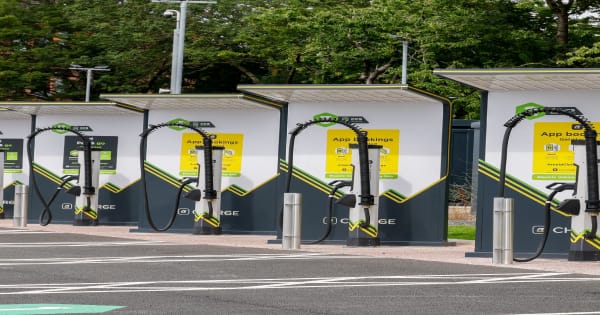

Enjoy ultra-rapid EV charging at just 55p/kWh, plus free coffee while you charge on our UK-wide ultra-rapid EV charging network!
Learn more